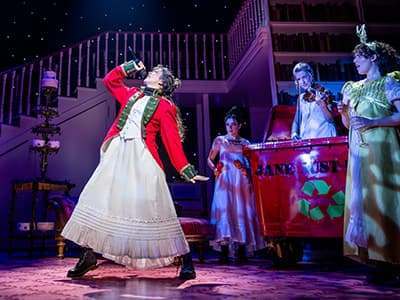
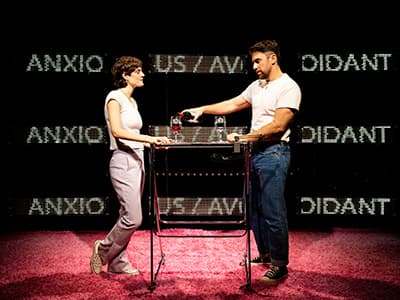
Left - Cast. Cover - Glenn Hazeldine & Max Cullen. Photo - Brett Boardman
Being a play set at the dawn of John Howard’s tenure and whose title directly evokes the era of our other long-running Liberal PM Bob Menzies, it is evident that one’s response to this material may vary – not only according to politics, but also class and especially by generation.
Although better known to the general public in his persona as Rampaging Roy Slaven, John Doyle has long been a figure on the entertainment scene, working under his own name as an actor, a radio host, and as a writer, having penned two notable television miniseries in the past decade, Changi and Marking Time. It would be fair to say that Doyle is something of an Australian icon, and this, his first stage play The Pig Iron People, is a piece of work that both beguiles and bemuses.
A multilayered script, the story concerns Nick, a former teacher and aspiring writer who has lost his marriage and, for a while, his mind, before coming to live in a rented inner-city house in the working-class Sydney neighbourhood of Liberal Street, moving in on the eve of John Howard’s 1996 election to office. He is initially shocked by the outrageous personalities of his three sets of blue-collar neighbours, but in the same evening meets the actress April at a party, and is smitten. What follows is a sweet, tentative (but fairly straightforward) love story interwoven with Nick’s interactions with his eccentric neighbours who increasingly fascinate him and prove a source of inspiration for his writing. As the play moves along we learn through Nick about the personal backstories of each character, eventually gaining insight into why they are as they are.
On this level, The Pig Iron People works well, presenting a collection of well-drawn characters who can encompass both considerable humour and tragedy as each personal history unfolds. There’s not much plot to speak of and it may be a little soapy for some tastes, but that seems to matter very little as these various vignettes and encounters all work quite effectively as human drama.
Not to mention the fact that the play is also, perhaps unsurprisingly, very funny. Hilarious, at times. Doyle has crafted some genuinely memorable characters (facilitated in no small part by the terrific cast) who generate both hilarity and sorrow, and although they certainly appear to be larger than life they also have an undeniable ring of truth to them.
So from the perspective of humour, drama, character and narrative (such as it is), the play is an engaging, entertaining and at times moving work. Where the piece is more problematic, however, is in its apparent thematic and political aims.
As an older member of Generation Y, I’ll be the first to admit that my experience of some of the politics which this play touches on is vicarious, and that I am doubtlessly not the target demographic at which this show is aimed. Advertised as a being about how two generations have been formed by the politics of their respective eras, the play in fact is mostly attempting to compare (if not even conflate) the national mood of the conservative Menzies era with that of the forthcoming Howard years. Expressed through Nick we are given a bleak premonition of the decade to come and how he fears it will repeat the culturally and morally stifling climate that produced this neighbourhood.
While this is an interesting and possibly quite valid perception of our social history, the problem is that the message just doesn’t transmit in a convincing fashion. The characters in the neighbourhood are relatively disparate, and beyond being working class and conservative have very little in common, and their outrageousness as personalities seems to trample any sense that they appear to have been intended to represent Menzies’ ethos of aspiring to Queen & Country middle-class respectability. Which is not to say that there were never real people who behaved like this and voted for Menzies, merely that if Doyle’s goal was to portray them as representative of a particular social climate then this intent has been severely diluted. Perhaps the playwright fell a bit too in love with his characters, or felt it was important to avoid using them as mouthpieces for the politics of Menzies’ time.
If so, he evidently felt no such compunction when it came to the Howard years, as the far more open scenes that discuss his forthcoming reign are far from subtle. Although, granted, Doyle is preaching to the choir, it is preaching nevertheless, and for all the lack of clarity in dealing with the Menzies half of his sociopolitical equation, he goes just as far in the other direction with Howard.
Works set in past decades that make play with the audience’s appreciation of future events perhaps require a bit more distance in time to seem incisive rather than smugly knowing, which is the path Doyle seems to be treading here. Laced with retroactively prescient comments (some of which are very witty) that become increasingly heavy-handed, one can’t help but wonder if the same script will seem more resonant once we have more distance from the Howard era. Either that, or perhaps instead it is simply a base requirement to have actually lived through both eras in order to fully appreciate this piece.
There is, however, one scene that really steps into didactic territory, depicting Kurt the crazy, ultra right-wing German neighbour launching on a tirade about how Howard will be the strong leader this country needs, that change is in the wind and all the multiculturalists, artists, welfare bludgers, gays, aborigines etc. all better watch out because the people have spoken. It seems unlikely that Doyle was operating out of complete ignorance of the principle of Reductio ad Hitlerum, so perhaps he thought the comedic aspect of the play might shield this rather ham-fisted moment from serious criticism, but no such luck. Although one may well wish to compare many of Howard’s political views with aspects of fascism and even find it a fairly attractive perspective, to portray a thinly-veiled Nazi spewing out a monologue about what a great prime minister John Howard is going to make has all the subtlety of a crate of sledgehammers, and risks seriously undermining the credibility of the surrounding text. Also naming the most consistently unpleasant (yet perversely amusing) character in the show John “Jack” Howard doesn’t exactly smack of finesse either.
But even if one turns a blind eye to these missteps, ultimately the main problem is that the final play just doesn’t seem to bear out these intergenerational ideas very strongly. Had it merely been used as a subtext or major theme this might have seemed more natural, but as it is the play largely falls short of its stated purpose. Were it not for the title, advertising and a couple of specific scenes, one could easily view the sociopolitical angle in this piece as indeed being a background element at best, leaving the impression at times that Doyle is reaching.
As already said, however, the drama of the play is very effective, and while Doyle certainly deserves the credit for this, his script is given a considerable boost from the excellent cast, who are all marvellous. Glenn Hazeldine is endearing as the fourth-wall breaking lead Nick, as is Caroline Craig as April, Max Cullen is great value as always in the aforementioned role of Kurt, and Bruce Venables is perfect as the jovial but troubled former truckie Claude. Judi Farr delivers one of her patented downplayed performances as the embittered, tragic Janette, and while Jackie Weaver is as ever so distinctive as to seem typecast she remains something of a national treasure. Inarguably, though, the scene-stealer throughout the play was Danny Adcock as Jack, the abusive, self-important, domineering busybody of the neighbourhood who flies into a literally screaming rage at the slightest provocation. Although perhaps technically a bit of a caricature, the role has an oddly believable quality despite its extremity, and in Adcock’s hands is so unrelentingly hilarious that it’s a genuine surprise that he is still capable of transferring this into considerable pathos by the play’s end.
The Pig Iron People is a play that is likely to get some interesting and varied reactions out of its audience. It is a play of considerable charm, humanity and a great deal of humour, and yet one which is clearly grasping for some wider ideas that seem unfortunately a little beyond its reach.
Sydney Theatre Company and UBS present
THE PIG IRON PEOPLE
By John Doyle
Venue: Drama Theatre, Sydney Opera House
Season: 1 November 8pm - 13 December 8pm
Evenings: Tuesdays – Saturdays 8pm, Mondays 6.30pm Adults: $77 Concession: $62
Matinees: Wednesdays 1pm (Wednesday 26 November at 12.15pm) Saturdays 2pm Adults: $68 Concession: $56
Night with the Actors: Monday 10 November 6.30pm
Bookings: (02) 9250 1777 sydneytheatre.com.au